When “What Are You?” Becomes More Than a Question
The Dignity Beneath the Question
The way a question enters a conversation matters because words can carry harm even when spoken with a smile. “What are you?” often arrives as curiosity, casual conversation, or quick social observation. To the person asking, the moment may feel brief and harmless. For a mixed girl, especially one who has heard the question repeatedly, the words can feel like an inspection before recognition. Her face, hair, skin tone, features, name, and family structure become the evidence someone believes they have a right to examine before deciding how to understand her.
A person is not a “what.” A child is not a category waiting to be named by someone else. A mixed girl is not a visual puzzle, an unusual specimen, or a collection of physical traits placed before the world for public interpretation. When the first question someone asks reduces her to what she appears to be, the message can feel degrading before any real relationship has begun.
Plenty of people defend the question by saying they were “just curious,” but curiosity has a time, place, and relationship. Most adults understand the rudeness of walking up to someone they do not know and demanding an explanation about a visible difference in their body. Basic decency teaches us not to treat another person’s appearance as an invitation for interrogation. Mixed girls deserve the same respect.
The question can stir emotions a child may not yet have language for. Embarrassment may rise first, followed by anger, confusion, shame, or the awful feeling of being pulled outside of herself and placed on display. A mixed girl can feel belittled in a moment everyone else treats as ordinary. The room may continue moving as usual, while her body is trying to process why her identity has suddenly become public conversation.
The harm deepens when the question turns into a follow-up interview. People may ask which parent is Black, white, Mexican, Asian, Native, or anything else they are trying to locate. Family questions may follow, especially when someone wants to know which parent “gave her” certain features, skin tone, hair texture, or cultural markers. Those questions move beyond identity and into family privacy. A mixed girl should not have to explain her parents, family history, or ancestry to satisfy someone else’s curiosity.
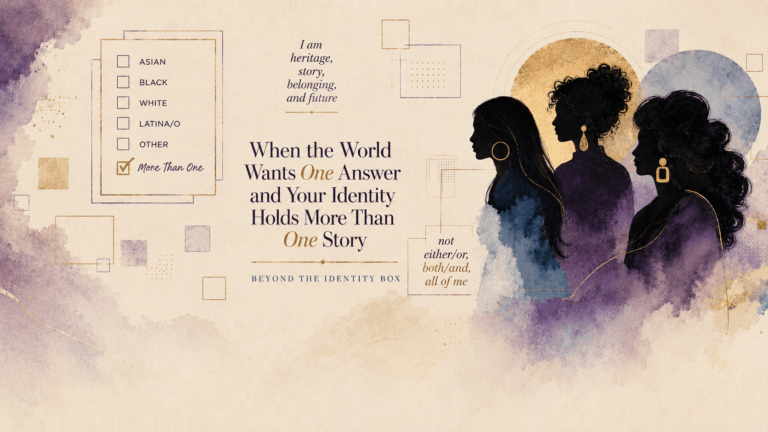
A similar harm happens when other people decide the language for her. “So you’re half Black and half white,” or “You’re half this and half that,” may sound neat, but human identity does not always work through someone else’s fractions. Genetics, ancestry, culture, family, lived experience, and self-understanding do not fold perfectly into a stranger’s simplified sentence. A mixed person may choose to use “half” language for herself, and self-identification deserves respect. Another person assigning those fractions without permission is very different.
Accuracy matters, but authority matters more. When someone else decides the language before a mixed girl has named herself, the conversation teaches her that identity can be taken from her mouth and rearranged by someone else’s assumption. Correction, disbelief, laughter, debate, or surprise can turn one answer into a lesson about power.
Self-identification is not a small detail in mixed-race identity development. At its strongest, self-identification is where dignity, language, history, body, family, culture, and belonging begin to come together. A mixed girl needs room to understand herself without being rushed into someone else’s categories. As she grows, her words may evolve through knowledge, family stories, cultural connection, and lived experience. Growth does not make her earlier language false; growth means she is becoming more fully connected to herself.
Adult responsibility begins at the source of the harm. The burden cannot keep falling on the mixed girl who is being questioned, corrected, diminished, or placed on display. Mixed girls can be equipped with words and boundaries, but preparation should never be mistaken for responsibility for someone else’s behavior.
Families, classrooms, churches, ministries, youth programs, and community spaces have to confront the behavior directly. Adults who ask invasive questions, laugh at identity, assign fractions, challenge self-identification, demand family details, or treat a child’s appearance as public information are participating in the very harm mixed girls are often told to manage politely. The expectation cannot be that the mixed girl absorbs discomfort, protects an adult’s feelings, and finds a graceful way to recover from being degraded.
A parent, educator, relative, ministry leader, coach, or mentor should not treat “What are you?” as innocent just because the person asking claims no harm was intended. Impact, repetition, public setting, tone, power, and relationship determine whether a question feels like dialogue or intrusion. When the person being questioned feels punished, exposed, belittled, or reduced, the conversation has already crossed a boundary.
Corrective work must include the people doing the questioning. Adults need to teach children and correct other adults when curiosity becomes entitlement. Family members need to stop making racial identity a guessing game, a joke, or a debate. Educators need to interrupt classroom comments that turn a mixed child into a lesson, spectacle, or argument. Ministry and community leaders need to recognize that spiritual language cannot be used to cover cultural harm. Sacred spaces still have a responsibility to confront racial bias, identity-based teasing, family intrusion, and the quiet ways children are made to feel like outsiders among people who claim to love them.
Better language begins with humility, but better behavior begins with accountability. A person with genuine relationship might ask, “How do you describe your background?” or “What words feel most true to you?” Even then, the answer should be received, not cross-examined. Dignity requires the discipline to let a person be the authority over her own story.
The practical truth is clear: curiosity is not automatically care. Genuine care respects timing, relationship, consent, and humanity. Without those things, curiosity becomes entitlement dressed up as friendliness, and the person causing harm gets protected while the person carrying the harm is expected to be gracious.
A mixed girl deserves more than a world that studies her before it welcomes her. Her identity is not less real when someone else does not understand it, and her dignity does not depend on how well she explains herself under pressure. Belonging should not require performance, proof, disclosure, or emotional labor on demand.
Dear Mixed Girl, you are not a question waiting for someone else to answer. You are not a fraction, a guessing game, or a body placed before the world for inspection. Your identity belongs to you, and your dignity remains intact whether you explain yourself, name yourself, protect your story, or allow your wholeness to stand without apology.
Be blessed and be at peace.
Dr. KayLa N. Allen-Young
Dear Mixed Girl® is a growing body of writing centered on identity, belonging, emotional intelligence, cultural proficiency, and the human experience of becoming.
Created by Dr. KayLa N. Allen-Young, this work explores the ways people learn to understand themselves, navigate relationships, develop self-awareness, and move through environments that often encourage performance over authenticity. Through writing, speaking, workshops, coaching, and educational experiences, Dear Mixed Girl® supports girls, families, educators, leaders in children-centered organizations, and the communities that influence how people see themselves and others.
Explore More Dear Mixed Girl® Writing